
 By Oscar James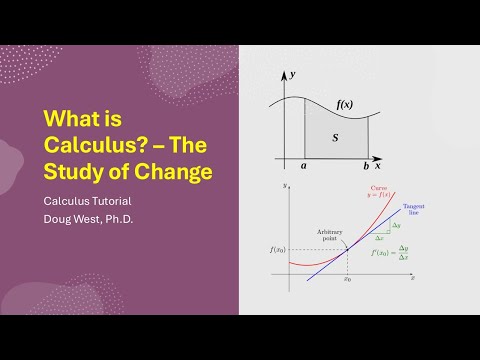
Calculus is a branch of mathematics that studies change and accumulation. It provides powerful tools for analyzing how quantities vary over time and space, making it an essential subject in science, engineering, economics, medicine, and computer science. Developed independently by Isaac Newton and Gottfried Wilhelm Leibniz in the late seventeenth century, calculus has become one of the cornerstones of modern mathematics.
At its core, calculus answers two fundamental questions: How fast is something changing? and How much has accumulated over time? These questions are addressed through two main branches of calculus: differential calculus and integral calculus.
Limits: The Foundation of Calculus
The concept of a limit forms the basis of all calculus. A limit describes the value that a function approaches as its input gets closer to a particular point. Instead of focusing on the value of a function at a single point, limits examine the function’s behavior near that point.
Limits are used to:
- Define derivatives
- Define integrals
- Analyze continuity
- Evaluate functions near undefined points
- Study infinite sequences and series
Without limits, the concepts of differentiation and integration would not be mathematically rigorous.
Continuity
A function is said to be continuous if there are no sudden jumps, breaks, or holes in its graph. Informally, a continuous function can be drawn without lifting the pencil from the paper.
Continuity is important because many theorems in calculus, including the Intermediate Value Theorem and the Fundamental Theorem of Calculus, require functions to be continuous over a given interval.
Differential Calculus
Differential calculus studies the rate at which quantities change. Its primary tool is the derivative, which measures the instantaneous rate of change of a function with respect to one of its variables.
Geometrically, the derivative represents the slope of the tangent line to a curve at a particular point.
Applications of derivatives include:
- Calculating velocity and acceleration
- Finding maximum and minimum values
- Measuring growth and decay
- Optimizing engineering designs
- Training machine learning models
Several rules simplify differentiation, including the Power Rule, Product Rule, Quotient Rule, and Chain Rule.
Applications of Derivatives
Derivatives are widely used to solve optimization problems. Businesses maximize profits and minimize costs using derivative analysis, while engineers optimize structures for strength and efficiency.
Scientists use derivatives to model changing physical systems such as:
- Motion of vehicles
- Population growth
- Heat transfer
- Chemical reactions
- Fluid dynamics
Because derivatives describe instantaneous change, they are indispensable in physics and engineering.
Integral Calculus
Integral calculus focuses on accumulation. Instead of measuring how fast something changes, integration measures the total quantity accumulated over an interval.
Common applications include:
- Calculating the area under curves
- Finding volumes of solids
- Measuring total distance traveled
- Determining work done by a force
- Computing probabilities
Integrals are classified into two categories:
Definite Integrals
A definite integral computes the exact accumulated value between two specified limits. It has numerous applications in geometry, physics, and engineering.
Indefinite Integrals
An indefinite integral determines the family of antiderivatives of a function. Since differentiation and integration are inverse operations, indefinite integrals “undo” differentiation.
Several techniques are commonly used to evaluate integrals:
- Substitution
- Integration by Parts
- Partial Fractions
- Trigonometric Substitution
- Numerical Integration
The Fundamental Theorem of Calculus
One of the most important results in mathematics is the Fundamental Theorem of Calculus, which establishes the connection between differentiation and integration.
It shows that integration and differentiation are inverse operations. This relationship allows definite integrals to be evaluated using antiderivatives, greatly simplifying many mathematical problems.
Infinite Series
Calculus also examines infinite sums known as series. Infinite series are used to represent complicated functions with simpler polynomial expressions.
Important series include:
- Geometric Series
- Harmonic Series
- Power Series
- Taylor Series
- Maclaurin Series
Taylor and Maclaurin series are particularly valuable because they allow complex functions such as exponential, logarithmic, and trigonometric functions to be approximated accurately.
Multivariable Calculus
Many real-world problems involve more than one variable. Multivariable calculus extends the concepts of differentiation and integration to functions of several variables.
Topics include:
- Partial derivatives
- Multiple integrals
- Gradient vectors
- Directional derivatives
- Vector fields
- Divergence and curl
These concepts are fundamental in electromagnetism, fluid mechanics, computer graphics, and machine learning.
Differential Equations
Differential equations describe relationships involving functions and their derivatives. They are used to model systems that change over time.
Applications include:
- Weather prediction
- Population dynamics
- Electrical circuits
- Disease spread
- Planetary motion
- Economic forecasting
Many scientific discoveries rely on solving differential equations accurately.
Real-World Applications
Calculus has transformed countless fields of study.
Engineering: Designing bridges, aircraft, robots, and communication systems.
Physics: Modeling motion, gravity, electricity, and quantum mechanics.
Economics: Maximizing profits, minimizing costs, and predicting market trends.
Medicine: Medical imaging, drug dosage calculations, and disease modeling.
Computer Science: Artificial intelligence, computer graphics, optimization algorithms, and data analysis.
Environmental Science: Climate modeling, pollution analysis, and resource management.
Conclusion
Calculus Concepts is much more than a collection of formulas—it is a mathematical framework for understanding change, motion, and accumulation. Its concepts, including limits, continuity, derivatives, integrals, infinite series, multivariable functions, and differential equations of a spacecraft, developing artificial intelligence systems, or optimizing business operations, calculus remains one of the most powerful tools for solving complex real-world problems. A solid understanding of calculus concepts equips students and professionals with the analytical skills needed to innovate and address challenges, provide the foundation for modern scientific and technological advancements.